


UPS Runtime: Why the Same VA Rating Gives Different Backup Time
UPS Runtime: Why the Same VA Rating Gives Different Backup Time
Why does the same VA rating give different backup time? UPS runtime depends on the energy stored in the batteries, the watts your equipment actually draws and how efficiently the UPS delivers that energy.
 Key Takeaways
| What to know | What to do |
|---|---|
| VA measures apparent power, not stored battery energy. | Compare both the VA and watt limits with the equipment you plan to keep running. |
| Battery voltage and amp-hours together give a better picture of nominal energy. | Estimate watt-hours, then allow for conversion losses and energy the UPS cannot deliver. |
| Your connected equipment’s real watt draw determines how quickly the battery is used. | Measure normal use and account for changes in demand and startup surges. |
| Runtime does not increase in direct proportion to battery size or decrease in direct proportion to load. | Use a runtime curve at the watt load you expect to run. |
| Battery age, temperature and cut-off voltage affect usable energy. | Keep batteries in suitable conditions and replace worn batteries with compatible units. |
| The right UPS capacity depends on your equipment and the work you need to protect. | Compare models in our UPS range by both their output limits and runtime information. |
VA and watts describe output limits, not backup energy
A UPS VA rating tells you its apparent power capacity, calculated from voltage multiplied by current. Watts measure real power, the power your equipment actually uses, and the power factor connects the two figures. That is why VA and watts are not interchangeable.
Your equipment can remain below a UPS’s VA limit while exceeding its watt limit, or the other way around, so check both before connecting a load. The VA rating is an output-capacity figure, not a battery-size or runtime figure.
Two 1000 VA UPS units can contain different battery arrangements and deliver different backup times, even when both can support the same apparent-power load.
How many VA should your UPS be? Choose a capacity that covers the equipment you need to protect, its watt and VA demand, and any startup demand, with headroom for changing loads.
Do not size it from the maximum number on the UPS alone. Size it in this order:
- List every device that must stay on and measure its normal watt draw.
- Check the combined load against both the UPS’s watt and VA limits, including startup peaks where relevant.
- Choose a model with capacity above those measured demands, leaving room for load changes or planned additions.
- Check that model’s runtime curve at the combined watt load and confirm it gives enough time for your intended task.

Battery voltage and amp-hours set the stored energy
To estimate nominal battery energy, multiply battery voltage by capacity in amp-hours (Ah). The result is watt-hours (Wh), which gives you a more useful starting point for estimating runtime than Ah alone.
A battery rated at a given number of amp-hours cannot be compared with another on that figure alone if their voltages differ. UPS designs also use different battery voltages, capacities and configurations, so the same VA rating does not mean the same stored energy.
Battery arrangement helps explain why the VA label tells you so little about stored energy. In a compatible series bank, battery voltages add while the amp-hour capacity stays the same; in a parallel bank, capacity adds while voltage stays the same.
The UPS must be designed for that arrangement, and batteries in a bank should be appropriately matched. Compare the complete bank’s voltage and Ah, rather than counting batteries or comparing Ah alone. Even watt-hours are not a promise of fully usable energy.
Battery discharge rate affects the capacity you can draw before the UPS reaches its battery cut-off voltage. ABB states that battery manufacturers’ nominal capacity values in ampere-hours typically refer to a ten-hour discharge (C/10) for lead batteries and a five-hour discharge (C/5) for NiCd batteries. When a lead-acid battery discharges faster than its rated test rate, its available capacity falls.
An external battery pack can add stored energy without changing the UPS’s VA output limit. That can extend runtime for a supported load, but it does not allow the UPS to run more powerful equipment than its output limits permit.
For a tower design with online double-conversion protection and add-on battery packs available to extend runtime, the Riello Sentinel Pro 1000VA (900Watt) UPS is a useful example of output capacity and battery expansion being separate considerations.
It is rated at 1000 VA and 900 W, and costs £166.63.
Use the equipment’s real watt draw, not its nameplate maximum
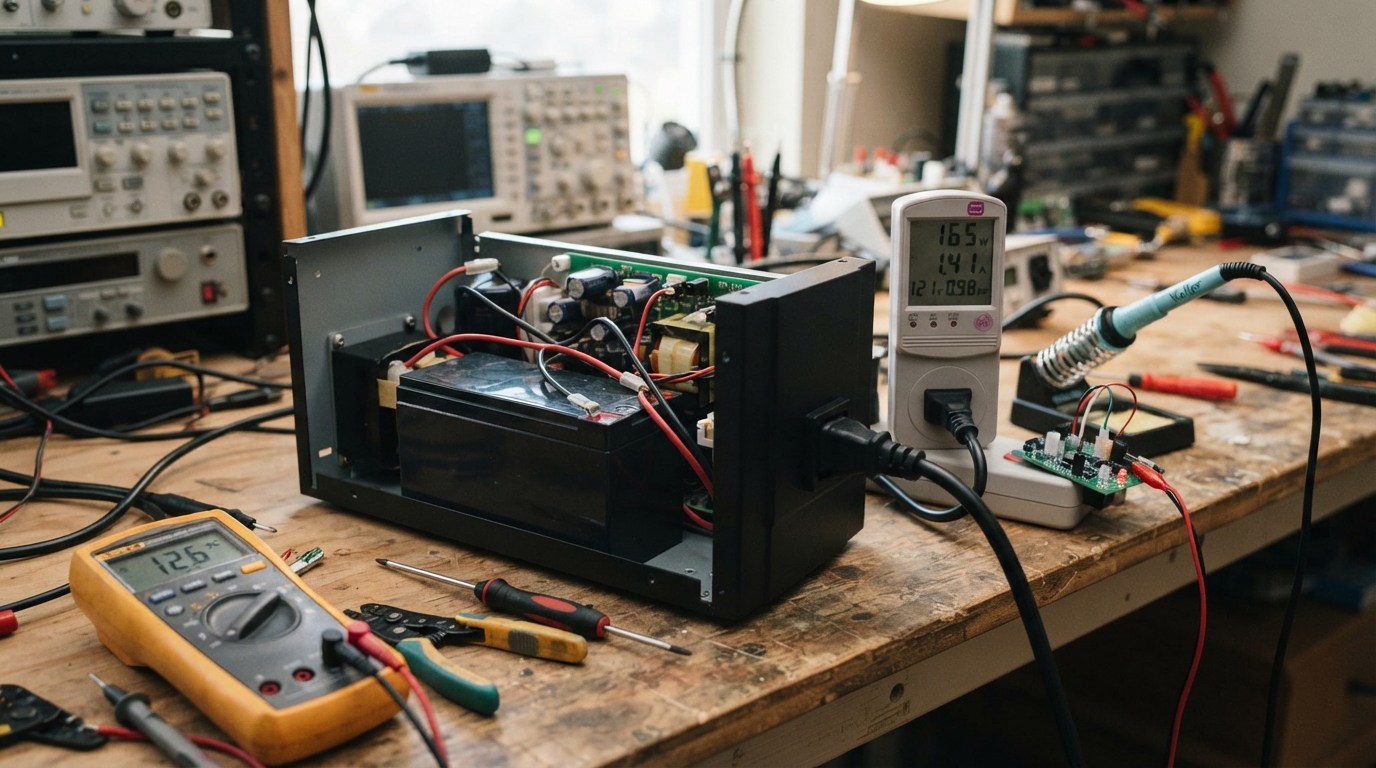
Your equipment’s nameplate rating often shows maximum input rather than the power it draws during ordinary work. Use a suitable plug-in power meter, or the UPS display where available, to measure operating watts.
Measure through a representative period of use. A computer’s processor and screen can change demand, while pumps and other equipment may cycle between operating states. Include brief startup surges when checking whether a UPS can support the equipment.
A surge may have little effect on average runtime, but it can exceed the UPS’s output limit and interrupt operation. For a combined setup, add the real watt draw of every device that needs to remain connected during an outage.
Do not use the UPS’s full rated load as a substitute for measuring your actual load. The APC Smart-UPS C 1000VA LCD 230V makes the distinction between output figures clear: it is a refurbished, line-interactive UPS with brand-new batteries, 600 W / 1000 VA capacity, pure sinewave output on battery, an LCD display and eight protected outlets.
Its £333.33 price buys a model with both VA and watt limits to compare against your measured equipment demand.
Estimate runtime, but allow for conversion losses and low-load draw
A rough estimate is runtime (hours) ≈ (battery-bank voltage × Ah × efficiency) ÷ load in watts. Use the battery bank’s voltage and Ah, not the UPS VA rating; efficiency represents the share of nominal battery energy that reaches the load.
This is a screening estimate, not a substitute for the exact model’s runtime curve. For a model-specific numerical check, the linked APC Back-UPS Pro BR650MI listing gives 64 minutes at a 40 W load.
That is its stated runtime at that operating point, not a result that can be inferred from 650 VA. For a battery-based estimate, substitute the bank’s voltage and Ah in the equation above, then apply a realistic efficiency allowance.
Compare the estimate with the exact model’s curve at your load: discharge rate, UPS self-consumption, cut-off and battery condition all affect usable energy. This is only a starting calculation.
At higher discharge rates, less of a battery’s nominal energy may be available before the voltage falls to the UPS’s cut-off point, so runtime will not scale neatly with either load or battery capacity.
Very low loads bring a different problem: the inverter’s idle draw and minimum operating consumption can take a meaningful share of the available energy. At small loads, inverter idle draw means halving the load can produce less than twice the runtime.
Use the manufacturer’s runtime curve for a closer estimate at the watt load you measured. Curves show real model-specific behaviour that a simple watt-hour calculation cannot account for.
The APC Back-UPS Pro BR650MI – Line-Interactive UPS – 650 VA/390W is rated at 650 VA/390 watts and has published runtimes ranging from 3 minutes at full load to 64 minutes at 40 watts.
It costs £151.60 and is a useful example of how runtime changes across different real watt loads, rather than following one fixed figure. The runtime figures and price above are those shown on the linked product listing.
For a decision, check the manufacturer’s runtime data for the exact model and the stated load and test conditions; a published curve point is an estimate under those conditions, not a guarantee for a different load or an aged battery.
Topology, temperature and battery condition change usable runtime
UPS design affects how much energy reaches the load. Online double-conversion units continuously convert incoming power, while line-interactive designs use a different power path; inverter efficiency and the UPS’s own consumption also vary between designs.
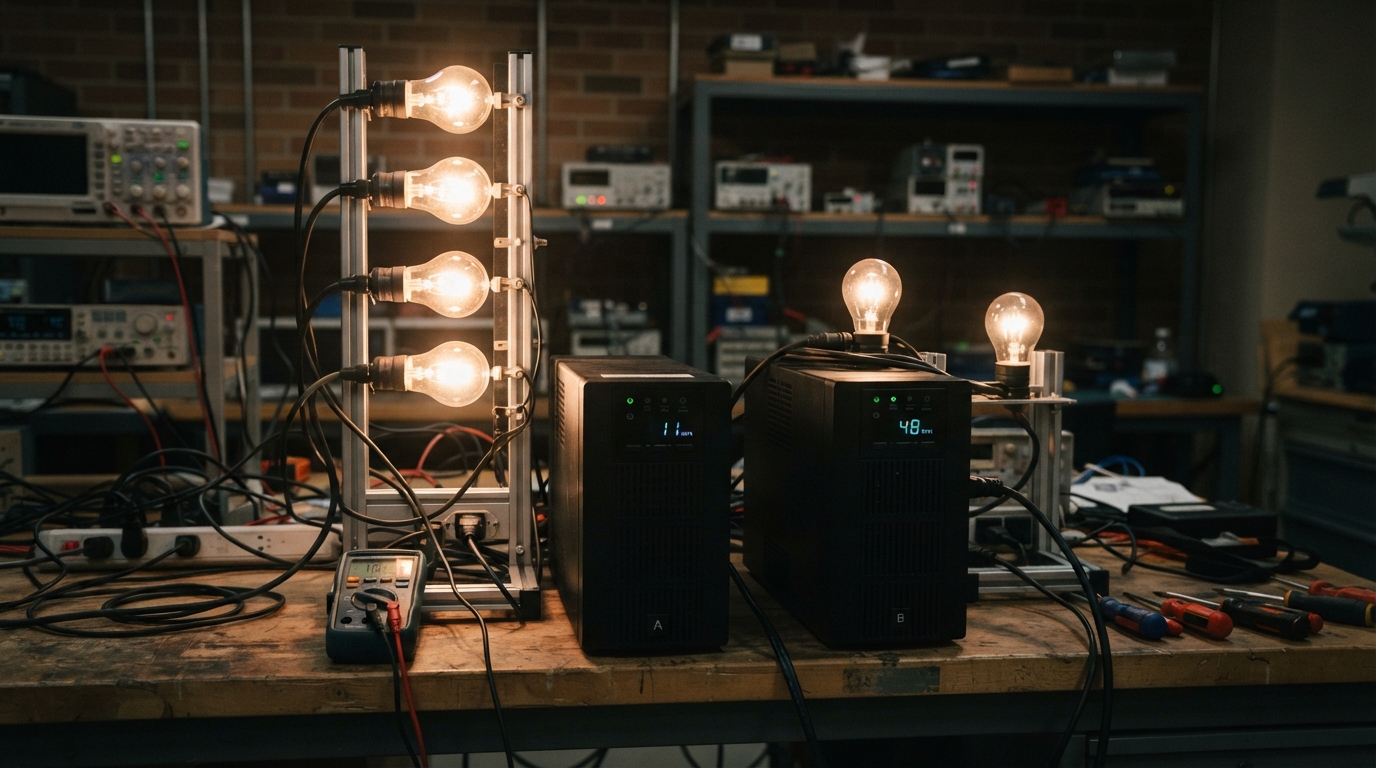
Topology alone does not tell you which model will run longer. Compare runtime figures at the same watt load, because that reflects the demand your equipment places on each UPS.
Battery ageing reduces capacity, so a runtime estimate based on a new battery can overstate what an older battery will deliver.
Heat accelerates battery ageing, while cold can reduce available capacity. Fuji Electric Corp. of America states that batteries perform best at optimal temperatures, typically 20-25°C or 68-77°F. Keep lead-acid batteries near this operating range and away from sustained heat.
Cut-off voltage matters too. Once battery voltage falls below the level required by the inverter, the UPS cannot deliver the energy that remains in the battery to your equipment.
When battery ageing reduces your backup time, a compatible replacement can restore the battery reserve your UPS needs. We offer APC replacement batteries for supported APC units.
Compare runtime claims at matching conditions
Compare runtime curves at the same watt load, not at the same percentage of each UPS’s rating. Equal percentages can represent different real loads, especially when models have different watt limits.
Check that the figures also use similar battery condition, temperature and test cut-off conditions. Each can change the available runtime, so different test conditions make a direct comparison unreliable. Read a runtime curve around your expected operating load.
The curve is usually non-linear, so estimating from a single maximum-load figure can give you a poor answer for lighter equipment. Set your target around the job the UPS must do.
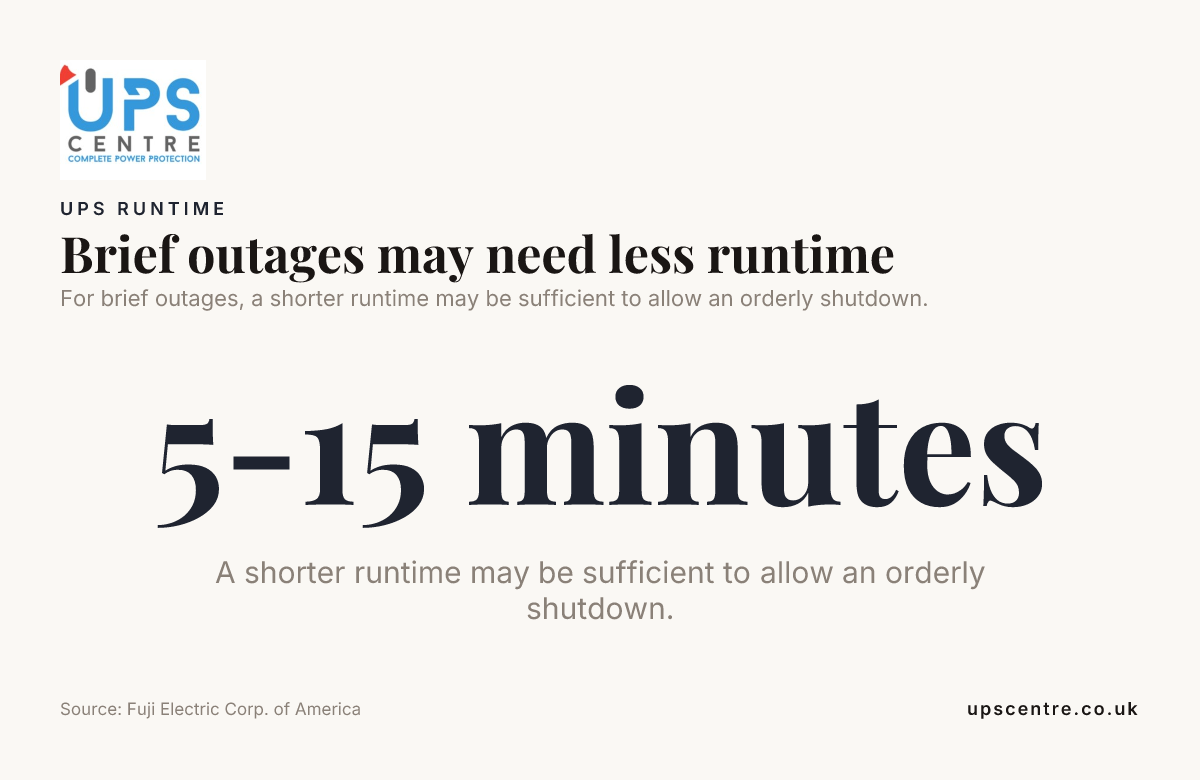
A short reserve may let you save work and shut down safely, while bridging a longer outage or waiting for a generator requires a different runtime target. Power cuts don’t announce themselves before they happen.
A UPS is your safety net for mains power interruptions, but choosing by VA alone can leave your home office or business with less time than you expect.

Frequently Asked Questions
How much backup time will an APC 600 VA UPS provide?
There is no single runtime for every APC 600 VA UPS, because the VA rating does not specify battery energy or the real load. Use the exact model’s runtime curve at your measured watt demand. For comparison, the linked APC Back-UPS Pro BR650MI listing states 64 minutes at 40 watts; do not apply that model-specific figure to a 600 VA unit.
Can a UPS runtime estimate be used for equipment that switches on and off?
Yes, but measure across a representative operating cycle and account for the time the equipment spends in each state. Repeated motor or pump starts can also create peaks that matter to the UPS’s output capacity.
Is it safe to connect a laser printer to a UPS?
A laser printer’s fuser can draw a high burst of power, so connecting it to a standard desktop UPS can overload the unit. Use a UPS only when its output capacity is designed to support that printer’s demand.
How often should I test a UPS battery?
Run the UPS’s built-in self-test regularly, following the manufacturer’s recommended interval, and test after a prolonged outage or a move. A self-test can flag battery problems, but it does not guarantee the runtime you need under your actual load.
Can I connect an external battery pack to any UPS?
No, the pack must be compatible with the UPS’s battery voltage, connection and charging design. Use a pack intended for that UPS model so the system can charge and manage it correctly.
Can I replace a UPS battery with one that has a higher Ah rating?
Only when the UPS supports that battery’s voltage, chemistry, charging requirements and physical fit. A higher Ah figure by itself does not establish compatibility or guarantee a particular runtime.
Distinction
UPS runtime: why the same VA rating gives different backup time comes down to a simple distinction: VA describes output capacity, while battery energy and the watts your equipment draws determine how long backup lasts.
Measure the real load, check both output limits, and use a runtime curve at a matching watt demand.
Then account for battery age, temperature, discharge rate and inverter consumption.
That gives you a more useful estimate, and helps keep your UPS working as a dependable safety net when the grid fails.
Need help?
Should you wish to discuss a particular application or requirement
Then please contact us free on 03300271309 or email us at sales@upscentre.co.uk

Tony Whittam
Specialist in digital marketing for more than 18 years, I am the co-founder and CEO of T & T Web Design. Affordable Search Engine Optimisation (SEO), PPC Management and Reputation Management.


